

 FR
FR DE
DE ES
ES NL
NL IT
IT DK
DK SE
SE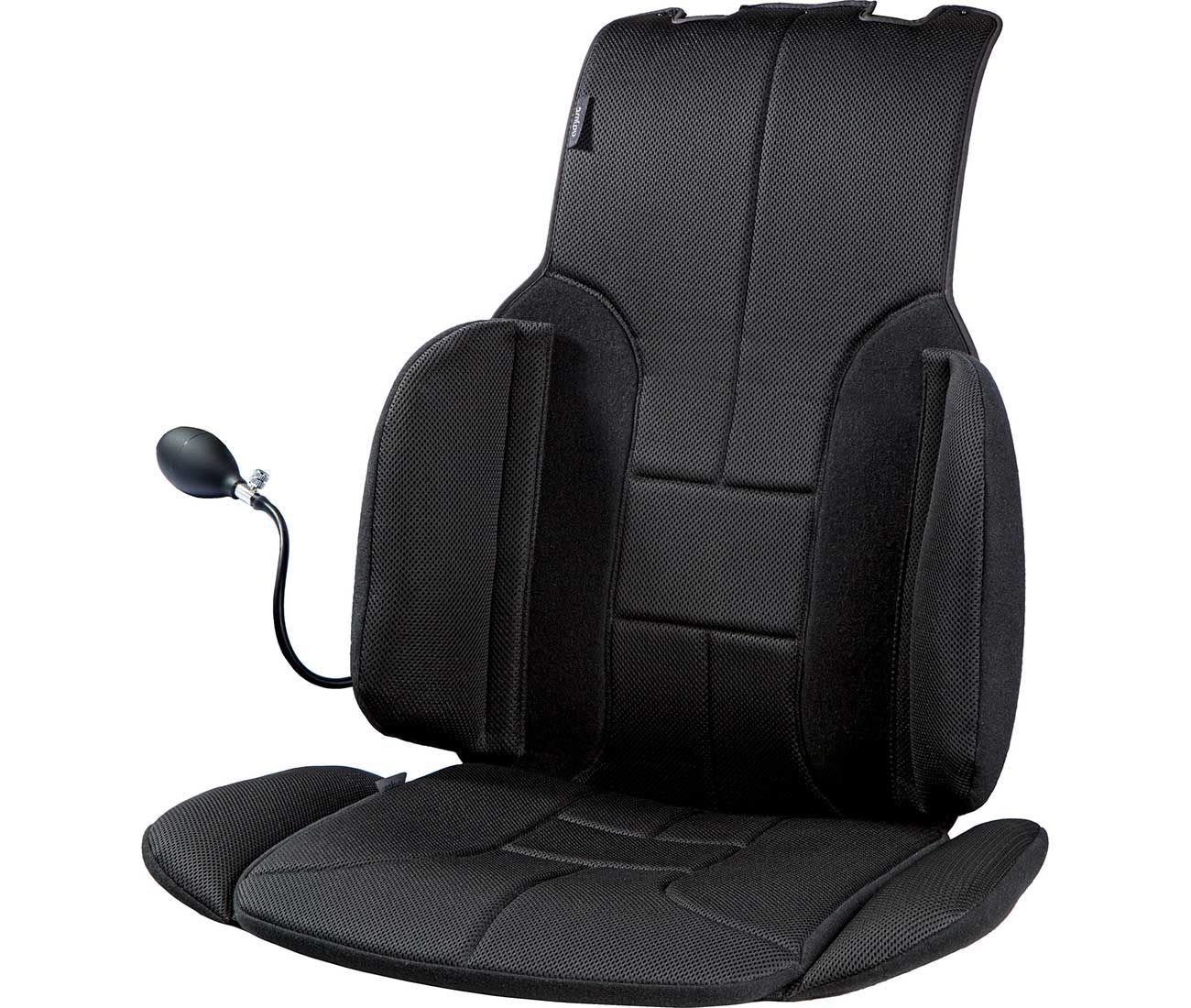
Car back lumbar support and car seat cushion Adjust
The Ad’just seat cushion and lumbar cushion are two distinct solutions that address two very concrete issues in the car: a “closed” posture (pelvis tilting back, legs too high, lower back tightening up) and a lack of lumbar support (the back “floats,” rounds, then starts to pull). Used separately, each already improves comfort; together, they form a complementary duo: the seat puts the body back into a better position, and the lumbar provides the precise support that was missing for the lower back.
The products can be sold together but also separately and independently from one another.
As low as €59.90
In stock
- Secure payment
- Delivery within 48 hours
- Satisfied or refunded
Restoring a more neutral posture
In the car, discomfort often sets in gradually. The seat base of many car seats is slightly tilted backward: the pelvis tilts, the lumbar curve flattens, and the torso/leg angle closes. The body then compensates reflexively by changing posture, shifting position, or arching. These repeated adjustments can end up increasing tension in the lower back.
The seat cushion acts first as a “base”: it is designed for cases where the seat base is too tilted. By raising and rebalancing pressure under the pelvis, it opens the torso/leg angle, helping you return to a more natural position. The goal is a posture where you don’t need to reposition yourself every 2 minutes: the pelvis is more stable, and lower-back tension decreases because you’re no longer “enduring” the seat tilt as much. It also adds stabilization features that better support the thighs, limiting pelvic rotation, for example when the road bends or the body slides slightly on the seat.
The lumbar cushion, on the other hand, addresses the other key point: even with good posture, if the lumbar area lacks support, you eventually “slump” or tense up. The Ad’just lumbar is designed to provide support exactly where your back needs it. The benefit is adjustability: thanks to an inflatable/deflatable membrane, you can fine-tune the support level to the right balance (not too firm, not too soft). And because driving involves constant micro-movements (vibrations, braking, turns), the cushion also includes adjustable lateral stabilization, to prevent the lower back from shifting left to right and “pulling” on a sensitive area.
The lumbar cushion and the seat cushion are complementary:
- the seat corrects the overall geometry (angle, pelvis, stability),
- the lumbar provides local support (lumbar curve + hold).
It is precisely this complementarity that explains why the same brand offers a “lumbar + seat” bundle: one creates a better posture, the other secures and relieves the area that works the hardest while driving.
Enhanced ergonomics: posture, support, adjustments
- Complementary: the seat improves overall posture (pelvis/torso-leg angle), while the lumbar provides targeted support for the lower back — two different actions that reinforce each other.
- Posture: the seat cushion “opens” the torso/leg angle, helping to limit a slumped position and the tension that appears when the seat is too tilted backward.
- Stability: with its stabilizers, the seat better supports the thighs and helps prevent pelvic rotation, particularly useful when chaining turns and micro-adjustments.
- Adjustable: the lumbar cushion adjusts via an inflatable/deflatable membrane, allowing you to very practically fine-tune how much support you want, depending on your body shape and sensitivity.
- Targeted: the lumbar is positioned on the lumbar area to provide precise support — the goal is to prevent the lower back from “floating” and compensating by tensing up.
- Hold: the adjustable lateral stabilization of the lumbar limits back movement, which can improve comfort when the road and driving cause repeated torso shifts.